How AI Works in Smart Homes
How AI works in smart homes is one of the most common questions beginners ask when entering the world of home automation. You may already use smart lights, smart speakers, or security cameras — but what makes them “smart” is Artificial Intelligence (AI).
In simple words, AI allows your home devices to learn, adapt, and make decisions automatically. Instead of you controlling everything manually, your home understands your habits and responds intelligently.
In this complete beginner guide, you’ll learn:
What AI in smart homes really means
How AI technology works behind the scenes
7 powerful benefits of AI-powered automation
Real-life examples
Safety and future trends
Let’s break it down step by step 👇
What Is AI in Smart Homes?
Artificial Intelligence (AI) in smart homes refers to technology that enables devices to:
Learn from user behavior
Analyze data
Make predictions
Automate actions
Unlike traditional automation (where you set fixed rules), AI systems can improve over time.
For example:
Traditional automation: Light turns on at 7 PM every day.
AI-powered automation: Light turns on when it detects you usually arrive home — even if your schedule changes.
AI combines:
Machine learning
Data analysis
Sensors
Cloud computing
Voice recognition
This combination makes your home smarter every day.
How AI Works in Smart Homes (Step-by-Step )
Now let’s clearly understand how AI works in smart homes.
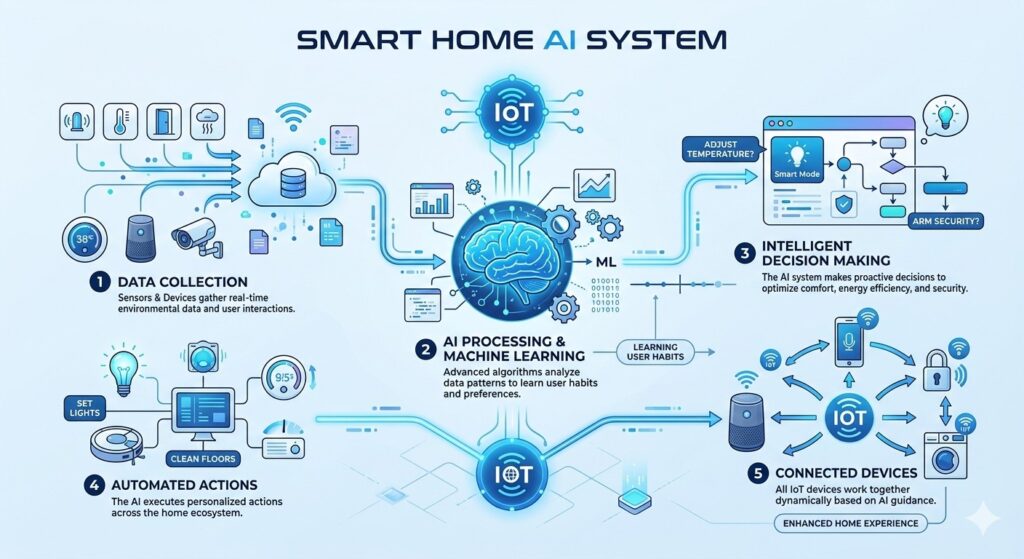
1️⃣ Data Collection
Smart devices collect data using:
Motion sensors
Temperature sensors
Cameras
Microphones
Usage history
For example, your smart thermostat records when you increase or decrease temperature.
2️⃣ Data Analysis
AI systems analyze patterns in that data.
If you lower the temperature every night at 10 PM, the system learns this behavior.
Machine learning algorithms detect patterns and trends automatically.
3️⃣ Decision Making
After learning patterns, AI makes decisions such as:
Adjust temperature automatically
Turn off unused lights
Lock doors at night
Detect unusual movement
This is what makes AI different from simple programmed automation.
4️⃣ Continuous Learning
The more you use your smart home, the smarter it becomes.
AI keeps updating its predictions based on:
New habits
Seasonal changes
Family routines
That’s the real magic of how AI works in smart homes 🧠✨
7 Powerful Benefits of AI in Smart Homes
Now let’s explore the real advantages.
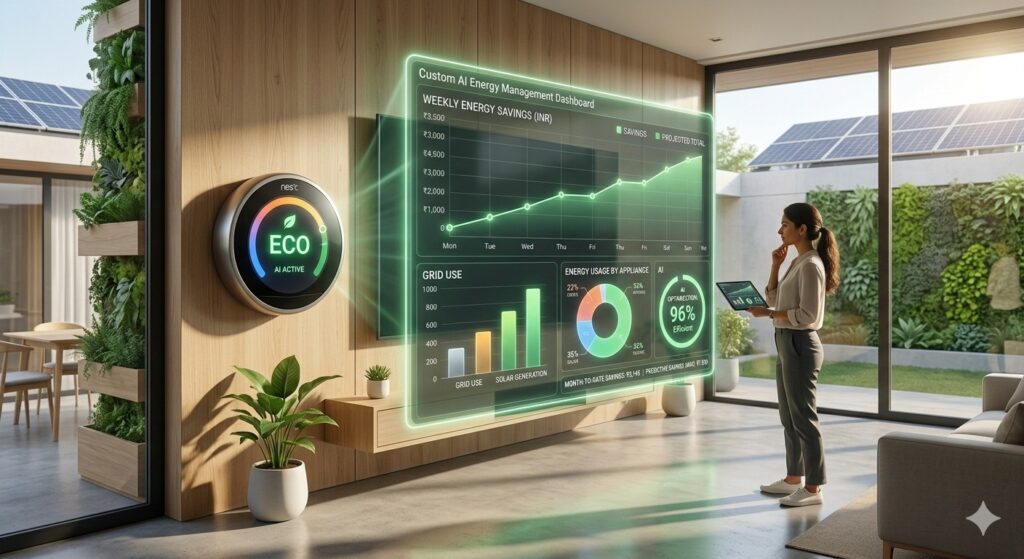
1. Smarter Energy Efficiency
AI helps reduce electricity bills by:
Turning off unused appliances
Adjusting thermostat automatically
Managing smart lighting
For example, AI-powered thermostats like those explained by the U.S. Department of Energy help reduce energy waste.
You can learn more about energy-efficient homes at the official U.S. Department of Energy website: https://www.energy.gov
Energy savings = lower bills 💰 + eco-friendly living 🌱
2. Advanced Smart Home Security
Security is one of the biggest benefits.
AI can:
Detect unusual movement
Recognize faces
Send instant alerts
Differentiate between pets and intruders
Modern AI home security systems use intelligent video analytics.
You can explore general AI security concepts at https://www.ibm.com/topics/artificial-intelligence
This makes homes much safer than traditional CCTV systems.
3. Voice-Control Convenience
Voice assistants use AI to:
Understand commands
Recognize accents
Respond naturally
Instead of pressing switches, you simply say:
“Turn off the lights.”
“Set temperature to 24 degrees.”
Voice recognition is a key example of how AI works in smart homes daily.
4. Predictive Automation
Predictive automation means your home acts before you ask.
Examples:
Coffee machine starts when you wake up
Lights dim at your bedtime
AC turns on before you arrive home
This predictive ability is powered by machine learning.
It improves comfort without extra effort.
5. Personalized Experience
AI personalizes settings for each family member.
Different lighting moods
Custom music preferences
Individual temperature control
Some systems even detect who entered the room and adjust settings automatically.
Personalization is a major reason why beginners choose AI-powered smart homes.
6. Cost Savings Over Time
While initial setup may seem expensive, AI saves money long-term by:
Reducing energy consumption
Preventing damage (like water leak detection)
Avoiding theft losses
According to research from energy efficiency studies, smart systems reduce waste significantly.
So AI is not just luxury — it’s a smart financial decision.
7. Improved Daily Comfort & Lifestyle
AI removes small daily frustrations:
No searching for switches
No worrying about locking doors
No manual thermostat changes
Your home works silently in the background.
That’s the real power of how AI works in smart homes — it simplifies life.
Real-Life Examples of AI Smart Homes

Let’s look at practical examples:
Smart thermostats adjusting automatically
AI security cameras detecting unusual activity
Smart refrigerators tracking grocery usage
Smart lighting adapting to sunlight
These are not future ideas — they are already available in many homes.
AI Smart Home vs Traditional Automation
| Feature | Traditional Automation | AI Smart Home |
|---|---|---|
| Fixed Schedule | Yes | Yes |
| Learns Behavior | No | Yes |
| Predictive Actions | No | Yes |
| Personalized Settings | Limited | Advanced |
| Continuous Improvement | No | Yes |
This comparison clearly shows why AI is the future of smart home automation.
Is AI in Smart Homes Safe?
Safety depends on:
Strong passwords
Two-factor authentication
Secure Wi-Fi network
Regular firmware updates
Always buy devices from trusted brands and update software regularly.
Cybersecurity awareness is essential for any connected home.
Future of AI in Smart Homes (2026 & Beyond)
The future looks even more exciting 🚀
Upcoming trends include:
Better emotional recognition
Smarter energy grids
AI-powered elderly care systems
Deeper IoT integration
Fully autonomous home management
As AI technology advances, smart homes will become more efficient and more human-friendly.
Conclusion
Now you clearly understand how AI works in smart homes and why it is transforming modern living.
To summarize:
AI collects and analyzes data
Learns user behavior
Makes intelligent decisions
Improves security
Saves energy
Reduces costs
Enhances comfort
For beginners, starting with one AI-powered device is enough. Over time, you can expand your system step by step.
Smart homes are not just about technology — they are about smarter living 🏡✨
FAQs
1. How AI works in smart homes for beginners?
AI collects data from devices, learns patterns, and automatically adjusts settings based on your habits.
2. Is AI necessary for smart home automation?
Basic automation works without AI, but AI makes systems smarter and more efficient.
3. Does AI increase electricity bills?
No. AI usually reduces electricity bills by optimizing energy use.
4. Are AI smart homes safe?
Yes, if you use secure networks, strong passwords, and keep devices updated.
5. What is the best AI device for beginners?
Smart thermostats, smart speakers, and AI security cameras are good starting points.