Table of Contents
AI Smart Home Security Guide for Beginners (Complete 2026 Protection Plan)
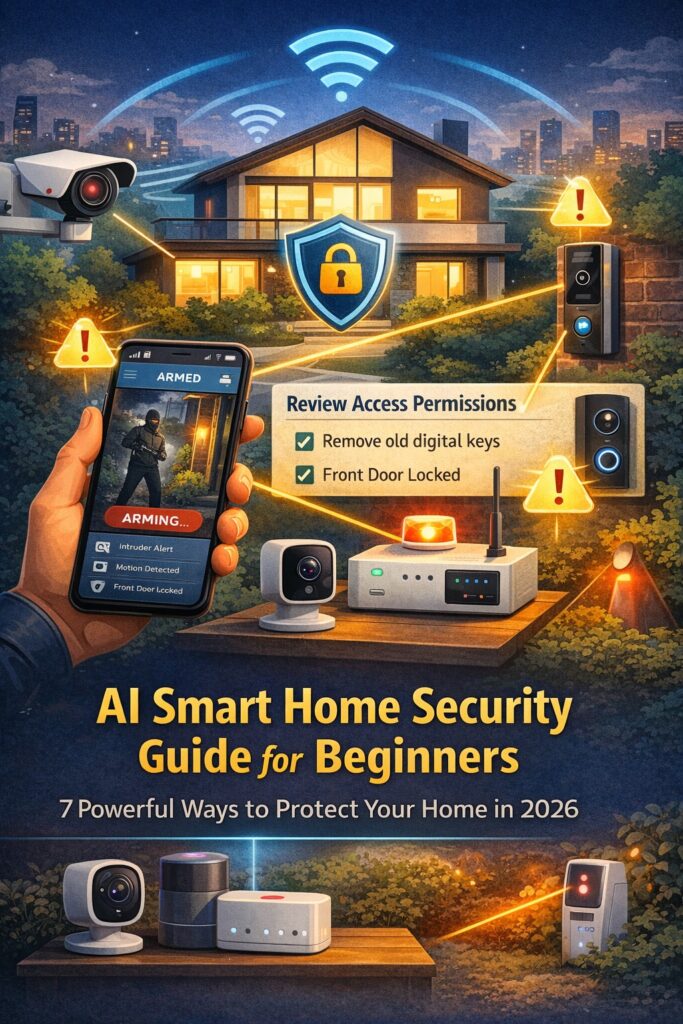
AI Smart Home Security Guide for Beginners is essential if you want to protect your home using intelligent automation instead of traditional alarm systems. As more households adopt AI-powered devices, security must become your top priority.
If you already read our guide on how AI works in smart homes and explored the best AI smart home devices for beginners, this article will help you secure your entire system properly.
In this expanded guide, you’ll learn:
How AI improves home security
7 powerful protection methods
Real-life security scenarios
Device comparison insights
Pros and cons of AI security
Beginner setup checklist
Cybersecurity best practices
Let’s secure your smart home step by step 🔐🏡
Why AI Security Is Better Than Traditional Security
Traditional systems:
Only record footage
Trigger alarms after intrusion
Cannot analyze behavior
AI-powered systems:
Learn daily patterns
Detect suspicious behavior
Reduce false alarms
Send instant mobile alerts
Automate responses
AI security systems rely on machine learning and computer vision principles. You can explore AI fundamentals at IBM’s official resource:
https://www.ibm.com/topics/artificial-intelligence
This explains how intelligent systems analyze data and improve accuracy over time.
How AI Works in Smart Home Security
Understanding this helps beginners trust the technology.
1️⃣ Data Collection
Cameras, sensors, and smart locks collect information continuously.
2️⃣ Pattern Learning
AI studies your family’s routine:
Entry times
Sleep patterns
Movement areas
3️⃣ Anomaly Detection
If activity doesn’t match usual behavior, the system flags it.
4️⃣ Automated Response
Lights turn on, alarms activate, notifications are sent.
This intelligent detection is the core of the AI Smart Home Security Guide for Beginners.

7 Powerful Ways AI Protects Your Smart Home
1️⃣ AI Smart Security Cameras
AI cameras can:
Recognize known faces
Detect unknown visitors
Identify suspicious packages
Ignore pets
Unlike traditional CCTV, AI drastically reduces false alerts.
Security standards and research guidance can be found at the National Institute of Standards and Technology (NIST):
https://www.nist.gov
2️⃣ AI Smart Door Locks
Smart locks allow:
Remote control
Temporary digital access
Activity tracking
Auto-locking
This eliminates physical key risks.
3️⃣ AI Motion Sensors
AI motion sensors:
Understand movement patterns
Ignore pets
Detect unusual activity
This prevents unnecessary alarm triggers.
4️⃣ AI Video Doorbells
Doorbells now:
Detect visitors
Record suspicious behavior
Send live alerts
Prevent package theft
Perfect for apartments and houses.
5️⃣ AI Threat Prediction
Advanced systems:
Detect repeated suspicious behavior
Analyze device login attempts
Predict possible risks
Predictive AI is what makes smart security powerful.
6️⃣ Smart Alarm Automation
AI integrates:
Cameras
Lights
Locks
Alarms
If danger is detected:
Lights turn on
Siren activates
Doors lock automatically
This reduces reaction time.
7️⃣ AI-Based Cybersecurity Protection
Smart homes are internet-connected. Digital protection is critical.
AI monitors:
Unusual login attempts
Suspicious network traffic
Malware risks
For cybersecurity best practices, visit:
https://www.cisa.gov
Always secure your Wi-Fi network.
Real-Life Security Scenarios (Important Section)
Let’s look at real examples:
Scenario 1: Midnight Movement
AI detects motion at 2 AM in backyard.
System turns on lights + sends mobile alert instantly.
Scenario 2: Package Theft Attempt
Doorbell camera identifies unknown person near delivery box.
You receive notification and speak through two-way audio.
Scenario 3: Suspicious Login
AI detects unusual login from unknown location.
System blocks access and alerts you.
These real-life examples show how the AI Smart Home Security Guide for Beginners works practically.
Device Comparison: Traditional vs AI Security
| Feature | Traditional Security | AI Smart Security |
|---|---|---|
| Records Footage | Yes | Yes |
| Learns Behavior | No | Yes |
| Predictive Alerts | No | Yes |
| Remote Control | Limited | Full |
| False Alarm Reduction | No | Yes |
| Automated Response | No | Yes |
AI clearly offers advanced protection.
Pros and Cons of AI Smart Home Security
✅ Pros
Intelligent threat detection
Fewer false alarms
Remote access control
Real-time notifications
Predictive protection
Higher peace of mind
❌ Cons
Requires internet connection
Initial setup cost
Needs proper cybersecurity habits
For beginners, benefits strongly outweigh limitations.
Beginner Setup Checklist (Very Important)
Follow this simple checklist:
✔ Install AI security camera
✔ Set strong password
✔ Enable two-factor authentication
✔ Update firmware regularly
✔ Secure Wi-Fi router
✔ Connect devices to guest network
✔ Test alerts weekly
This ensures strong protection.
How to Maintain Long-Term Security in an AI Smart Home
When following the AI Smart Home Security Guide for Beginners, installing devices is only the first step. Long-term protection depends on consistent monitoring, updates, and smart usage habits.
AI systems continuously learn from data. But if devices are not maintained properly, security gaps can appear over time.
Here are key long-term maintenance practices:
🔄 Regular Software Updates
AI security devices frequently release firmware updates. These updates:
Fix vulnerabilities
Improve threat detection accuracy
Enhance performance
Ignoring updates can leave your smart home exposed.
🔐 Review Access Permissions
Over time, you may give temporary access to guests, family members, or service providers. Regularly review and remove unused digital keys or app permissions.
📊 Monitor Security Logs
Most AI security systems provide activity logs. Checking these logs monthly helps identify:
Repeated login attempts
Suspicious activity patterns
Device connection issues
This proactive habit strengthens your security system.
🌐 Upgrade Network Protection
Your Wi-Fi router is the backbone of your smart home. Consider:
WPA3 encryption
Strong router passwords
Separate smart device network
Cybersecurity awareness is part of a complete AI Smart Home Security Guide for Beginners strategy.
🧠 Re-train and Optimize AI Settings
As your daily routine changes, update automation rules. AI improves with accurate data, so adjusting settings ensures better protection.
Long-term security is not about fear — it’s about smart maintenance. When you combine AI intelligence with responsible management, your smart home remains secure, efficient, and future-ready 🔐🏡✨
Common Security Mistakes to Avoid
Avoid:
Weak passwords
Ignoring updates
Connecting to public Wi-Fi
Buying incompatible devices
Installing too many devices at once
Smart security requires responsible usage.
Future of AI Smart Home Security (2026 & Beyond)
Expect future innovations like:
Emotion-based threat detection
Advanced facial recognition
Voice identity verification
Fully automated emergency response
Integration with smart city systems
AI security will become more predictive and autonomous.
Conclusion
This expanded AI Smart Home Security Guide for Beginners shows how artificial intelligence transforms modern home protection.
AI security systems:
Learn your routine
Detect unusual activity
Reduce false alarms
Provide instant alerts
Improve both physical and digital safety
If you already set up smart devices, securing them with AI should be your next step.
Smart homes are powerful.
Secure smart homes are unstoppable 🔐🏡✨
FAQs
1. Is AI smart home security safe for beginners?
Yes, most systems are user-friendly and app-controlled.
2. Does AI reduce false alarms?
Yes, AI analyzes patterns to minimize unnecessary alerts.
3. Do AI security devices need internet?
Yes, advanced AI features require internet connectivity.
4. Can AI detect real intruders?
Yes, AI cameras and sensors detect unusual behavior accurately.
5. Is AI smart home security expensive?
You can start with affordable cameras and expand gradually.